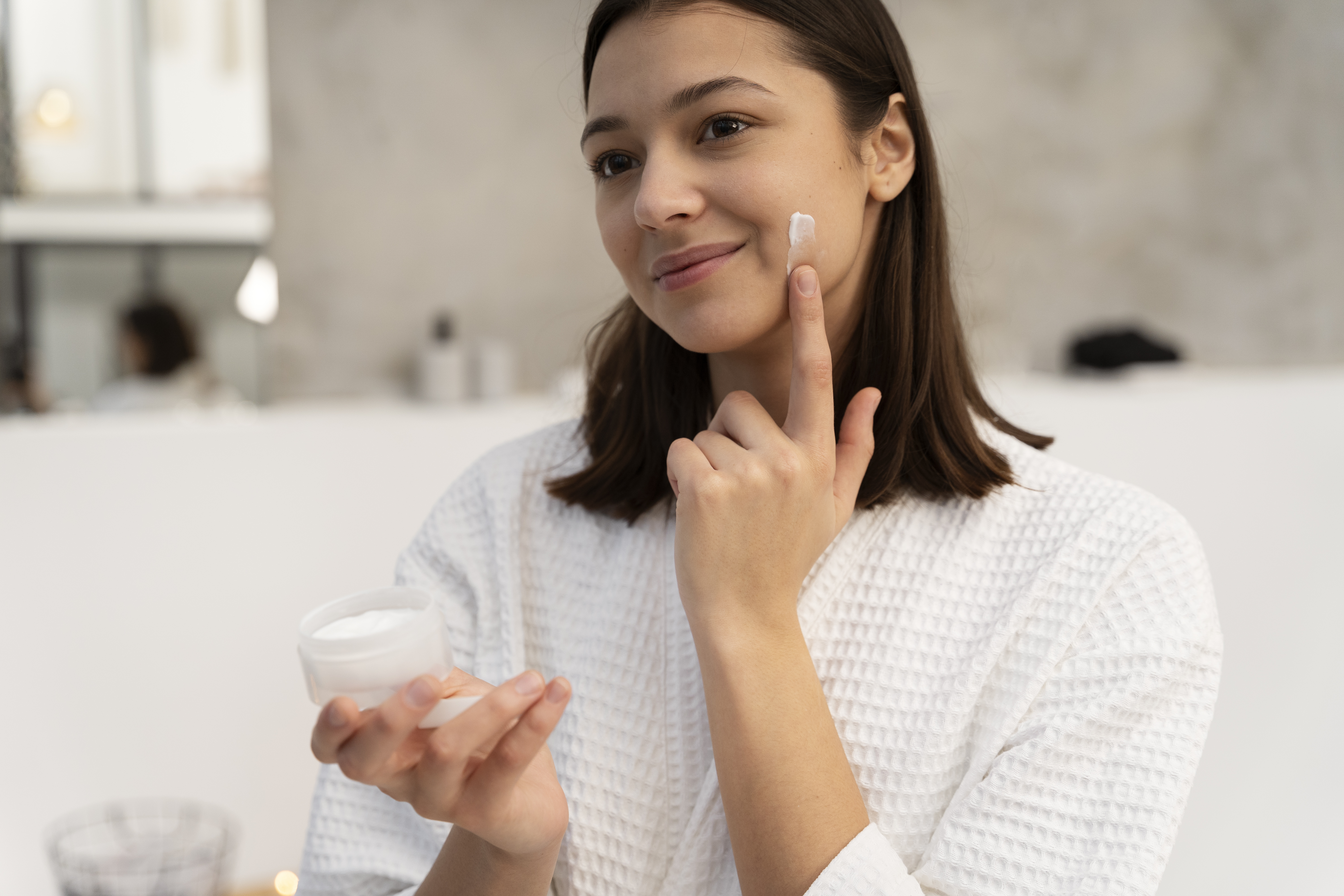
If you have paid any attention to skincare this year, you will have noticed the conversation shifting. The obsession with stronger acids and higher percentages has quietly given way to something less exciting and considerably more useful: repairing your skin barrier rather than repeatedly stripping it.
Ceramides are at the centre of that shift. Unusually for a trend, this one is worth following.
What your skin barrier actually is
Your outermost layer of skin is often described as a brick wall. The dead skin cells are the bricks, and a mixture of lipids holds them together as mortar. That mortar is roughly half ceramides, with cholesterol and fatty acids making up the rest.
Its job is to keep water in and irritants out. When the mortar breaks down, water escapes and everything you apply penetrates more deeply and less predictably than it should. That is when skin starts stinging at products it used to tolerate.
How you know your barrier is damaged
The signs are specific, and most people misread them:
- Serums that used to be fine now sting or burn
- Skin feels tight after cleansing and stays that way
- Redness that comes and goes without obvious cause
- Flaking alongside oiliness, which feels contradictory but is common
- Sudden breakouts in someone whose skin was previously stable
- Dullness that no amount of exfoliating fixes
Here is the trap. Every one of those symptoms reads as a problem to attack with more product. Dullness makes people exfoliate harder. Breakouts make people reach for stronger acids. Both make a damaged barrier worse, which produces more symptoms, which prompts more treatment. It is the most common skincare spiral there is.
What ceramides do about it
Applying ceramides supplies the same lipids your barrier is short of. They integrate into that mortar layer and reduce how much water escapes, which lets your skin stabilise instead of firefighting.
Unlike most actives, ceramides are not doing something to your skin. They are giving it back a material it already makes and has run short of. That is why almost nobody reacts badly to them, and why they can be used every day indefinitely.
Ceramide production also declines with age and drops with sun exposure, harsh cleansers, over-exfoliation, and swings between air conditioning and humidity. Which is to say most of us are running a deficit.
How to choose a ceramide moisturiser
Look for the supporting cast
Ceramides work considerably better alongside cholesterol and fatty acids, roughly in the ratio your barrier naturally uses. A formula with ceramides plus cholesterol beats one with ceramides alone, regardless of what the front of the box claims.
Ignore the percentage
Unlike niacinamide or vitamin C, ceramide concentration is not a useful signal. They work at very low percentages, and the ratio and formulation matter far more than the number.
Match the texture to your skin and your weather
This matters more in India than most guides admit. A rich ceramide cream that works beautifully in a Delhi winter will feel unbearable in a Chennai summer. Gel-cream ceramide formulas exist precisely for this, and there is no shame in owning two moisturisers for two seasons.
Check for niacinamide
A useful combination, because niacinamide increases your own ceramide production while the applied ceramides do the immediate work. You get repair from both directions.
What barrier repair actually looks like
If your barrier is compromised, the fix is mostly subtraction. For two to four weeks:
- Stop all exfoliation. All acids, all scrubs, no exceptions.
- Pause retinol and strong vitamin C.
- Switch to a gentle, non-foaming cleanser.
- Apply a ceramide moisturiser morning and night.
- Keep wearing sunscreen. This is the one thing you do not pause.
That is genuinely it. Three products. Most people find it uncomfortable because it feels like doing nothing, and doing nothing feels like giving up. But your barrier rebuilds on its own timeline and the only real contribution you can make is getting out of the way.
Reintroduce actives one at a time afterwards, a fortnight apart. If symptoms return, you reintroduced too fast.
Common questions
How long does barrier repair take?
Two to four weeks for most people to feel normal again. Severely compromised skin can take two to three months.
Can oily skin use a ceramide moisturiser?
Yes, and oily skin is frequently barrier-damaged from years of stripping cleansers. Choose a gel-cream rather than a heavy balm.
Are ceramides the same as hyaluronic acid?
No. Hyaluronic acid attracts water into the skin. Ceramides stop it leaving. In dry air, hyaluronic acid without something sealing it in can actually make skin drier.
Do I need ceramides if my skin is fine?
Not urgently, but they are a sensible everyday moisturiser and preventing barrier damage is far easier than reversing it.
This article is based on personal research and experience and is for general information only. It is not medical advice and does not replace consultation with a qualified dermatologist.
Leave a Reply